
A Tsunami Of Medicine
advances in drug discovery are increasingly likely to cause unprecedented pressure on our regulatory system, a discussion of second-order effects
23.09.26
AI has made some incredible advancements in biology over the past few years, and we're hoping for many more. (In fact, this may be our only chance to make good on our collective promise to society that in exchange for their trillions of dollars, we'll cure cancer!) We've made progress on protein folding and drug design, and it looks like we'll soon have a good hold on all the preclinical parts of drug development; from target identification, to hit and lead generation and optimisation, and even doing in vitro studies completely virtually a.k.a virtual cells.
Progress and funding is moving very quickly. Wet lab data is comparatively easy to generate in bulk, and can be used for training general AI models and improving their biological reasoning abilities. If everything goes well, we should optimistically be able to automate much of the preclinical discovery process in 2-4 years. However, as many have pointed out, (including Dario in Policy on the AI Exponential!), this is likely to become a problem; we will soon have thousands of new therapies, many of which target diseases we have no or bad cures for. That sounds fantastic, but ultimately every drug is a particular answer to a biological question, and there's only one way of finding out if it’s right: putting it inside a human. Clinical trials represent the slowest part of drug development, and it's clear they will become a bottleneck. While it's certainly a tragedy that useful drugs can take a long time to get approved, everyone agrees a slow miracle is better than no miracle. In this essay I'd like to discuss the clinical trial bottleneck more analytically, and why I think it might not just be frustratingly slow, but actively harmful for the medical establishment.
The Clinical Trial Bottleneck, by the numbers
This analysis is based on a clinical trial capacity model Claude and I made that covers several dozen diseases, play with it here.
Let's take cancer as an example, since we're already talking about it. Globally there were 2075 cancer trials started in the last year, of which about 315 were phase III. Based on our current track record, about 20 of these will turn into cancer drugs in 4-6 years (the rest either failing or for existing drugs’ new indications), and of those only about 10 will be an actually new target or a meaningfully large improvement.
Ok, so now let’s add AI to the picture. Let’s say for pancreatic cancer in particular (one of the most deadly cancers and a very important problem, particularly compared to “easier” cancers like melanoma - only about 13% 5-year survival!), upon achieving preclinical superintelligence a few years from now, let's say we have 250 new phase I drug candidates (up from a typical year of about 100), of which 35 actually work (again, unprecedented, but in line with data about AI-generated drugs' phase 1 success rate). There’s only about 66,440 pancreatic cancer patients in the US, and only about 4.2% of them annually enroll in clinical trials (due to doctors not recommending them, fears about placebos, and site problems), so we only have a budget of about 3,000 people to enroll per year. If we add in all the other countries capable of running cancer trials, including China, we get a global population of around 12,000 patients a year. Following the standard timelines, it will take over 27 years for the last drug we made that year to be approved!
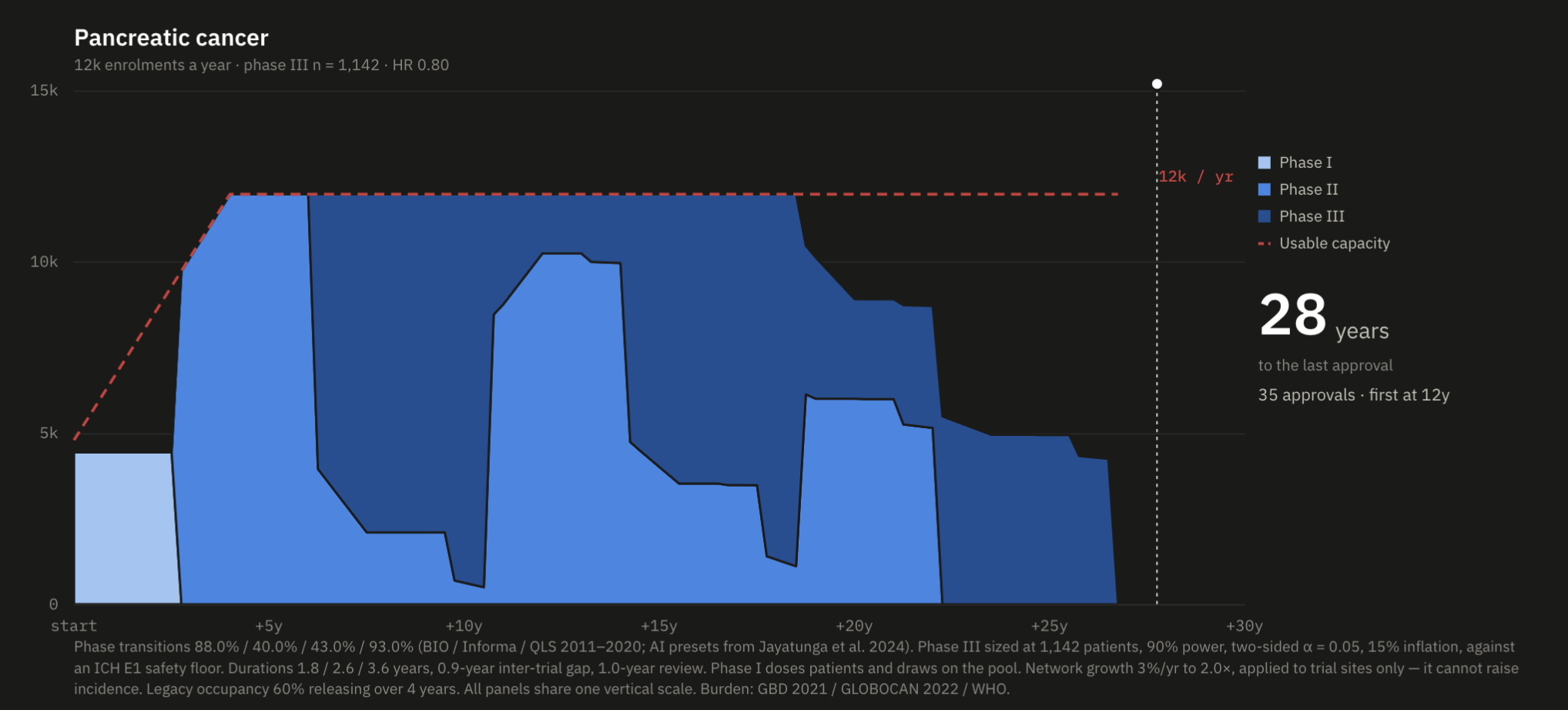
Now, it has been argued these theoretical AI drugs will have higher effect size, and thus require smaller trials - but even if we assume the drugs were twice as effective as the state of the art (which would be a fantastic breakthrough!), it still takes up to 13 years!
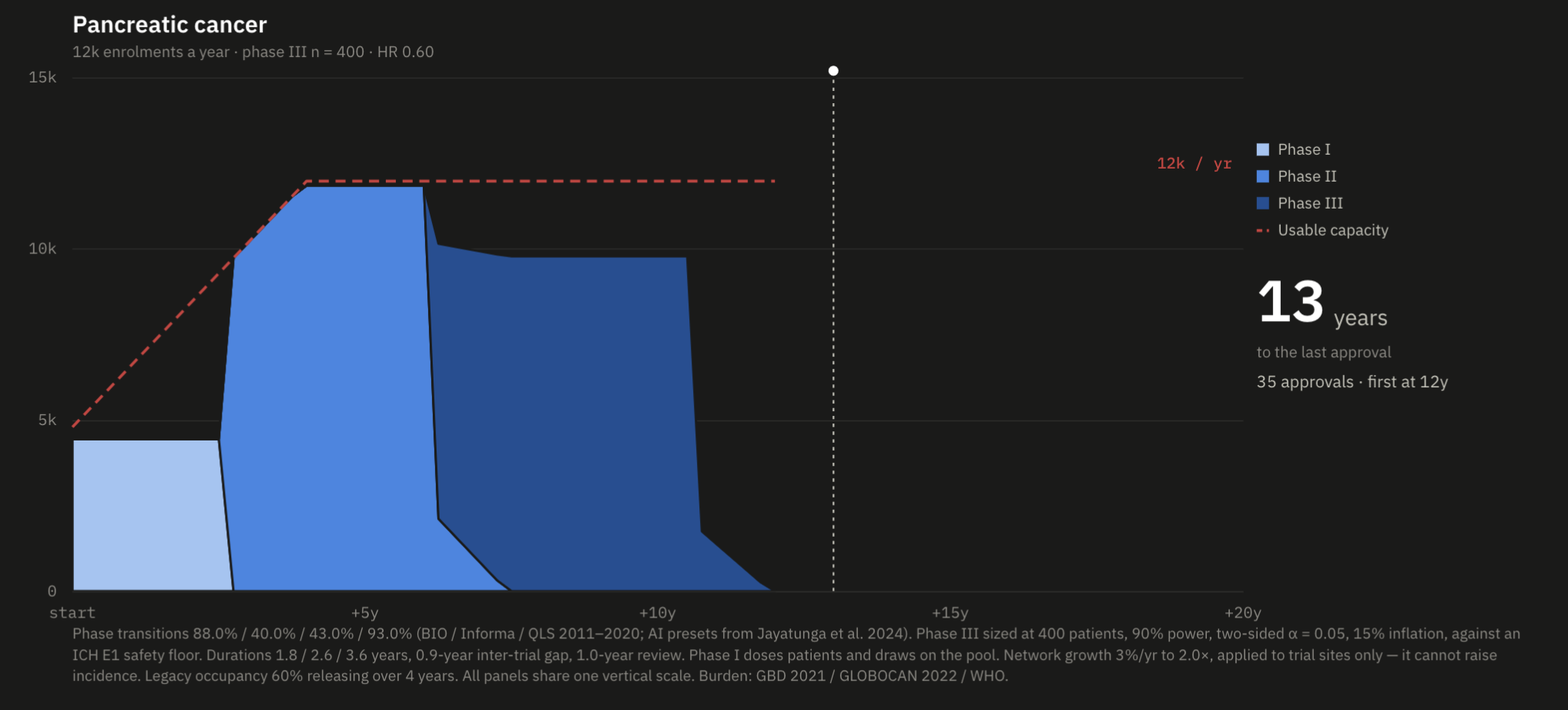
This is all while making the assumption that the new drugs have no biomarker specificity (which some likely will, reducing the effective patient population further). If we factor in reasonable assumptions for that, we can easily end up with longer times again. Interestingly, more effective drugs actually seem to strain capacity harder, since they're less likely to fail in phase 1, justifying even more phase 2 while allowing small phase 3.
I haven’t cherry-picked pancreatic cancer, either - the same thing happens for basically every highly deadly or rare disease. To be clear, I’m not very confident in these numbers in particular, since I’m using many assumptions to get them. I only bring them up these examples to highlight the fragility of the system - regardless of what parameters I pick, or what assumptions I make, there’s just no way we can process 1000 new drug candidates for every disease in time - a 5-10x increase in candidates - even if we run trials in every trial-capable country, and even if we try every trial design trick (e.g. platform trials, biomarker preselection, increased site throughput etc.)
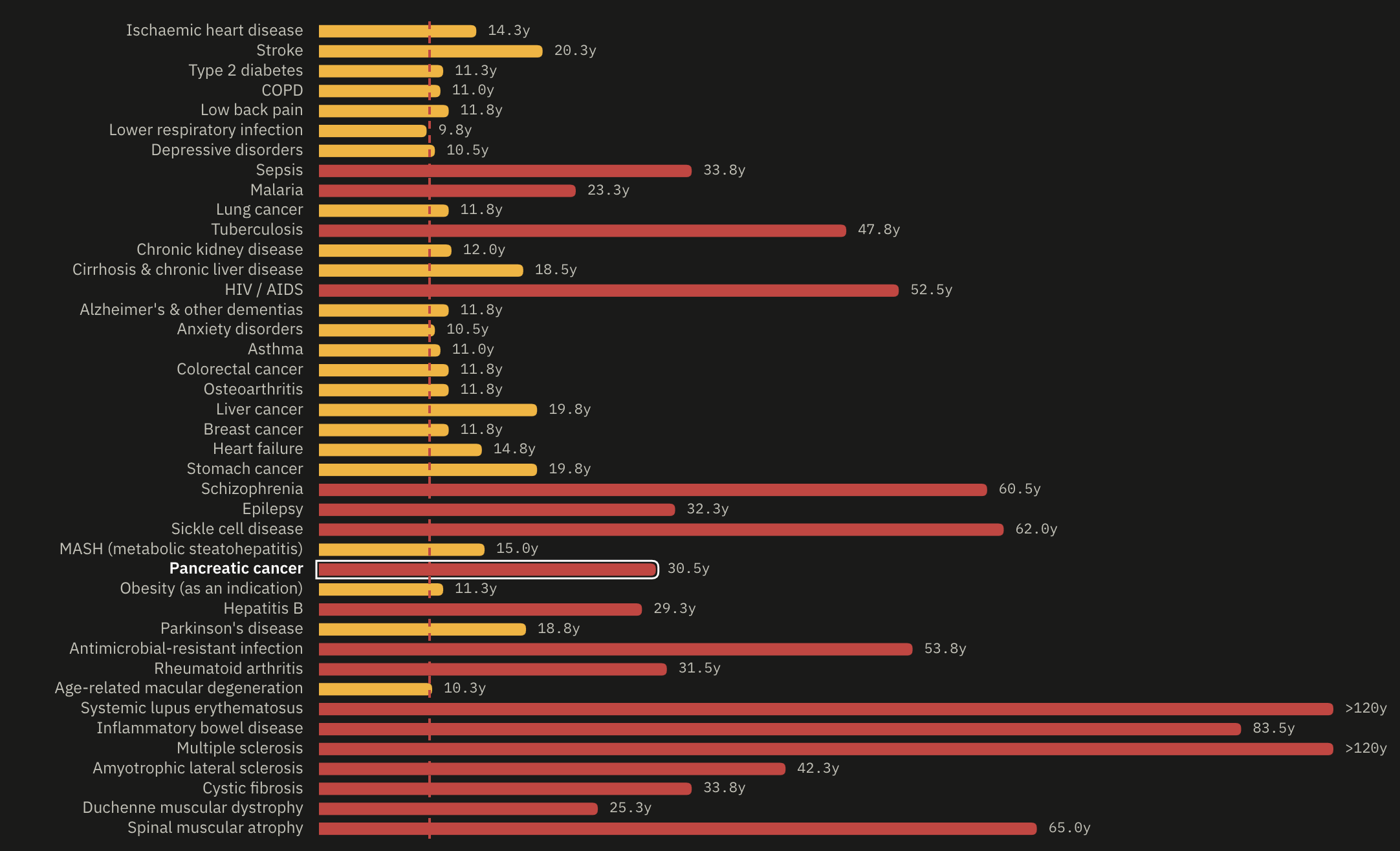
Society if 1000 new phase-1 drugs, each twice as effective as the current state of the art, hit the clinic at once with no trial optimizations
Due to the speed of capabilities increase in AI, and the downstream advancements in wet lab automation, in silico assays, and the effects of narrow recursive self-improvement, I think it’s actually pretty likely that we do end up in a world with thousands of new drug candidates for many rare diseases in the space of a year or two. For the reasons discussed above this might create a complete logjam, particularly in the late stages of drug development, that persists for years.
The Tsunami
The FDA is full of well-meaning people who are aware of the life-or-death consequences of their decisions. In general, when a true medical breakthrough comes along, they’re willing to speed up approval when lives hang in the balance. However, if every drug is a breakthrough, they can’t all have priority. Ultimately if we’re committed to running RCT trials as specified under current regulation, we can’t cheat statistics or biology, and there’s not much we can do to avoid the crunch. Changing regulation takes time, and changing law takes longer - I don't think they would ever seriously allow 100-year timelines for drug approval (particularly after recent cool new pathways), but avoiding them will require even riskier new regulatory ideas.
So put yourself in the shoes of a pancreatic cancer patient in the late 2020s. You know that your disease is not curable by current medicine. You know that there are drugs starting phase 2 right now that promise to finally make progress and double your chance of survival, backed by the strongest preclinical evidence we’ve ever had. You know they’re safe, and you know that even if the FDA pulled every lever to designate them all breakthrough therapies and get them approved quickly, it’ll still take years before you can have it, by which point you’ll almost certainly be dead.
What would you do?
We’re already seeing unprecedented levels of medicine piracy. Statistically, if you’re the kind of person who reads this kind of thing, you or someone you know has probably bought retatrutide powder as a “research chemical” from a Chinese lab and injected themselves with it. Maybe it worked for them, maybe it didn’t, maybe they got organ damage instead.
I suspect as AI gives us new handles on our biology, cures for all these rare diseases as well as general enhancements to sleep, cognition and health, people are not going to want to wait ten years or more to have them. As the wave of breakthrough drugs pushes clinical trial timelines into the decades, there will simultaneously be more demand than ever for the cures, and people will try to get them without waiting for approval.
While I’m optimistic we may be able to avoid the worst-case scenario wait times I’ve discussed in this essay with new innovations in the clinic, I’m less sure we’ll be able to hold back this countervailing demand rush. The result might be tragic for the healthcare establishment, since it will erode trust in doctors and regulators, and create a muddier and less safe information environment for patients. Either regulators will crack down on this kind of behaviour, or be forced to cave, creating more pathways for compassionate use, right to try, and so on.
I’m interested in thinking about solutions to this problem - I think it might involve better ways of getting causal human data and/or new institutions to provide that information to patients on their timelines.